
Review · ANDALUSIA WALKING TOURS
Seville Small-Group Monumental Highlights Walking Tour
Seville’s big monuments make more sense when someone connects them: a former mosque and its Giralda tower, a royal palace still in use, and a port tied to trade with the Americas. This small-group walk puts those landmarks into one compact route, finishing at Plaza de España.
I like two things in particular: the group is capped at 10, so you can ask questions without trying to speak over a crowd, and the guide explains the city’s layers of Muslim, Christian, and later Spanish history as you walk. The English-language tour costs $30.25, a fair price for a guided orientation.
The trade-off is that you see the monuments from outdoors, not from inside. Two hours is also a brisk introduction rather than a full exploration, and Plaza de España may close during a heavy wind alert.
Key points to know before you book
- The route covers a lot: City Hall, the Cathedral and Giralda, the Alcázar exterior, Torre del Oro, the former Tobacco Factory, and Plaza de España.
- The guide supplies the connective story: Expect history, architecture, and explanations of how different cultures shaped Seville.
- The group is small: No more than 10 people makes it easier to hear, ask questions, and keep the walk personal.
- It is an outdoor overview: Monument entry tickets and interior visits are not included.
- Plan for a little flexibility in timing: The tour is listed at about two hours, though the walk can take closer to two and a half.
- The finish is weather-dependent: The city council can close Plaza de España during a heavy wind alert.
A compact walk through Seville’s many layers
This tour is built for orientation. It starts at Plaza de San Francisco in the old center and ends at Plaza de España, taking in major landmarks along the way. Instead of spending the morning inside one attraction, you get a broad look at the city and a guide’s account of how the pieces fit together.
That format suits a first day in Seville. You can learn where the main sights sit, hear enough context to decide what deserves a longer visit, and note which buildings you want to enter later. The route is not a substitute for touring the Cathedral or Alcázar inside. It is a useful framework for making the rest of your time count.
The walk is outdoors, so you are in the streets and public spaces rather than watching the city through a bus window. The guide handles the route and commentary, leaving you free to look around and ask questions. The tour is offered in English, and the guide is licensed.
More walking tours in Seville:
- Seville: Small-Group City Highlights Walking Tour
★ 5.0 · 1,204 reviews - Cultural Walking Tour of Seville Monumental
★ 5.0 · 861 reviews - Seville: Tapas, Taverns, and History Walking Tour
★ 4.9 · 676 reviews
Starting at City Hall and Plaza de San Francisco
The meeting point is Plaza de San Francisco, beside Seville’s City Hall. The opening explanation uses the building to introduce Seville’s importance in the 1500s, giving you a first clue that this was more than a regional town. Its role in a wider world of politics and trade becomes clearer as the walk continues.
Starting with a building tied to civic life is a practical choice. It grounds the city’s story in a recognizable place before moving on to religious landmarks and royal power. The guide can also help you begin to get your bearings in the old center, where a street plan can feel less obvious when you are walking it for the first time.
The group limit of 10 helps here. A small group is easier to gather around a guide and gives you more room to ask questions. Guides such as Carmen, Laura, Miguel, Carlos, and Valentín have been praised for clear storytelling, warmth, and answering questions. Your guide depends on the date, but the format is designed to keep the experience personal.
Reading the Cathedral and Giralda from outside
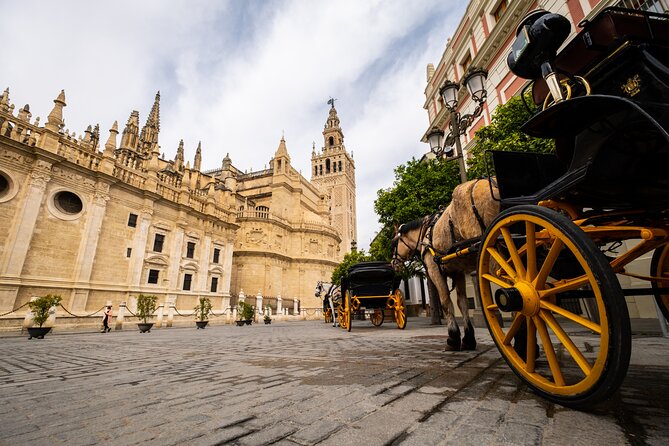
At the Cathedral and Giralda, the guide explains the earlier mosque and the way different religions and cultures shaped the city. The Giralda, now associated with the Cathedral, began as a minaret. That transition gives you a direct example of Seville’s changing religious and political life, rather than a string of dates without a visible connection.
This stop is about understanding the exterior and its setting, not going inside. You will not get the Cathedral’s interior, art, or detailed exploration on this tour. If those are high on your list, plan a separate visit and allow time for it. The walk’s value is that you can arrive at that visit with a clearer sense of what you are looking at.
A good guide can turn this kind of stop into more than a quick photo pause. Several guides are known for linking local events with wider Spanish and world history, and for making room for questions. One small caution: if you prefer a very light overview, a guide with a strong interest in history may give you more dates and detail than you can retain. You can steer the conversation by asking for the big picture.
Seville’s Atlantic trade and the Alcázar
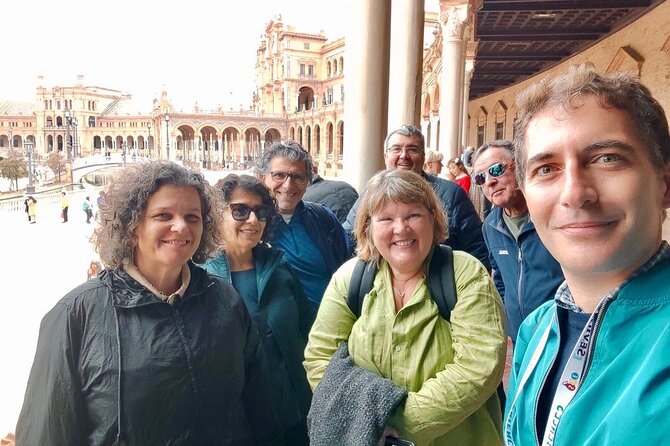
The walk next connects Seville with its role as a port and trade center for the Americas. That context helps explain why the city became so important in the 1500s and why its major civic and religious buildings carry such weight. The tour’s strength is not simply showing you a list of landmarks, but linking them to the city’s place in a larger history.
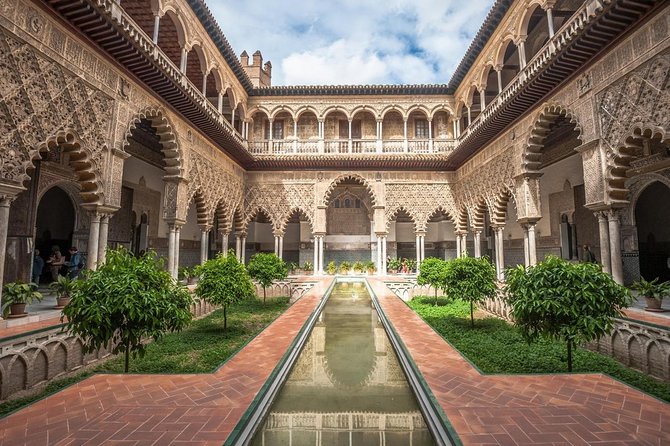
The Alcázar is another major stop, described from outside. It is presented as Europe’s oldest royal palace still in use, with rulers using the site since the 1000s. Even without entering, you can grasp why a palace with such a long history matters to Seville’s story.
But the exterior visit is also a clear limit. You will not see the palace rooms, gardens, or other interior spaces as part of this walk, and admission is not included. If the Alcázar is a priority, treat this tour as an introduction and arrange a separate visit. The guide’s background will help you understand the place, but it cannot replace time inside.
Same city, a different kind of day:
- Seville: Royal Alcázar Entry Ticket
★ 4.6 · 28,378 reviews - Seville: Cathedral and La Giralda Entry Ticket
★ 4.5 · 24,592 reviews - Seville: Live Flamenco Dancing Show Ticket at the Theater
★ 4.7 · 16,396 reviews - Seville: Casa de la Memoria Flamenco Show
★ 4.8 · 12,964 reviews
From Torre del Oro to the old Tobacco Factory
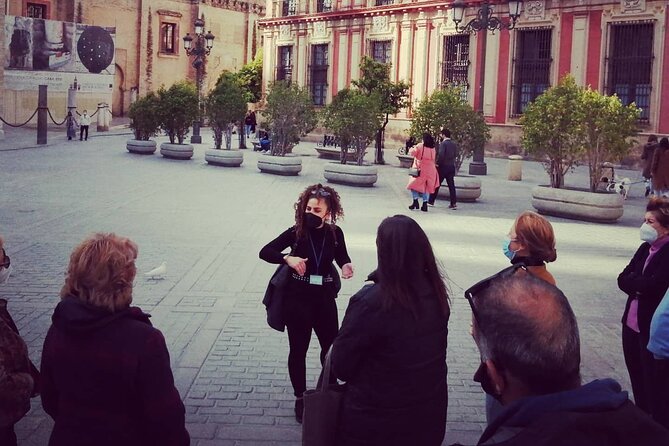
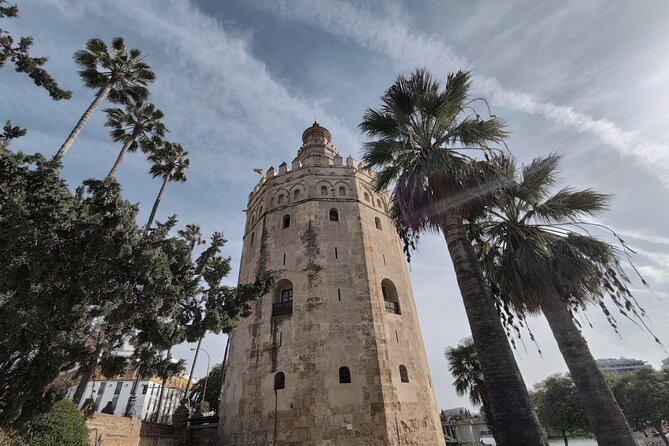
Torre del Oro adds another turn in the city’s story. The guide describes it as Seville’s last Muslim building and a watchtower that became an entry point to the city from the ocean. Its connection to the waterfront and sea trade makes it a natural partner to the earlier discussion of Seville as a port.
The old Tobacco Factory brings in a different period and a different kind of architecture. Built in the 1700s, it serves as an example of the city’s industrial past. This is a useful change of pace after mosques, churches, and royal residences. It shows that Seville’s story did not stop with its medieval and early modern landmarks.
Expect explanations from outdoors rather than a visit inside either building. The route gives you the broad picture, and you can decide later if you want to explore a particular site more closely. The stops work best as parts of a larger narrative, not as individual admission visits.
Ending at Plaza de España
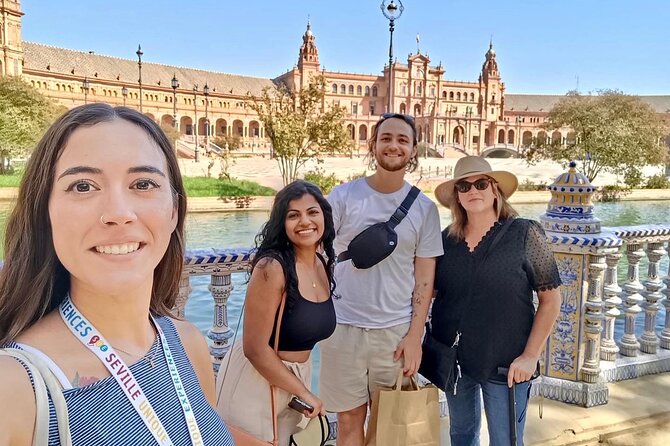
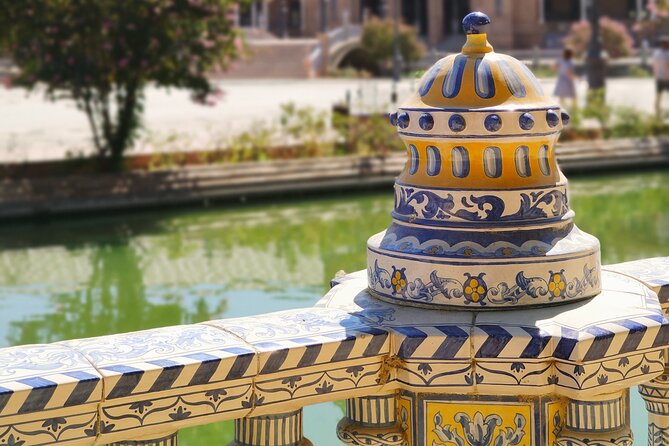
The walk finishes at Plaza de España, the grand pavilion built for the Ibero-American Exhibition. The guide explains how the exhibition changed Seville’s urban development and points to the host country pavilion as a major example. This closing stop takes the story from earlier trade and royal power toward the city’s more recent reshaping.
It is a satisfying end point because the plaza is a landmark in its own right and a good place to pause after the walk. Still, the city council may close it during a heavy wind alert. That is a real practical caveat, not just a small scheduling detail: the final stop is subject to local conditions.
The exact time on foot can vary. The tour is advertised as about two hours, while some walks have taken closer to two and a half. If you have a hard appointment immediately afterward, leave a buffer rather than planning around a strict two-hour finish.
What the guide adds to the experience
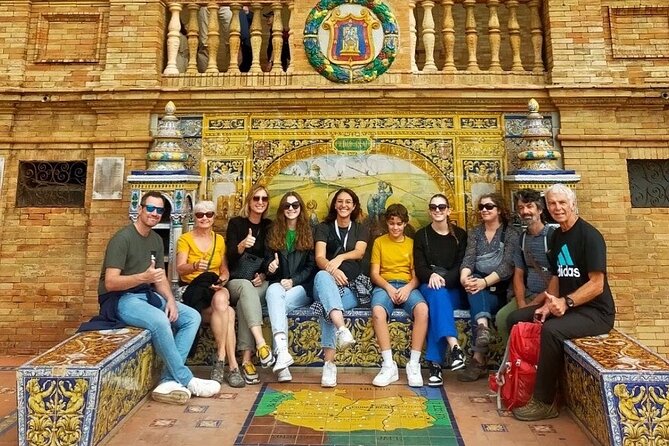
The guide is the main reason to choose this walk over tracing the same route on your own. Seville’s major sights are easy to recognize, but their layers can be harder to read without context. The guide explains how religious change, royal rule, Atlantic trade, and urban development shaped the city.
The strongest element is often the storytelling. Guides including Carmen, Laura, Miguel, Carlos, Valentín, Cristina, Marta, and Manuel have been praised for lively explanations, friendly delivery, and a willingness to answer questions. Cristina, for example, has been noted for keeping a measured pace, speaking clearly over street noise, and choosing shade when possible. Those details matter on an outdoor walk, especially in warm weather.
The experience can vary with the guide and the group. One guide may lean toward a dense account of dates and details; another may keep to a broader overview. If you want a lighter introduction, say so or ask questions that direct the discussion. If you enjoy history, this is a chance to ask how Seville’s story connects to Spain and the wider world.
Is $30.25 good value?
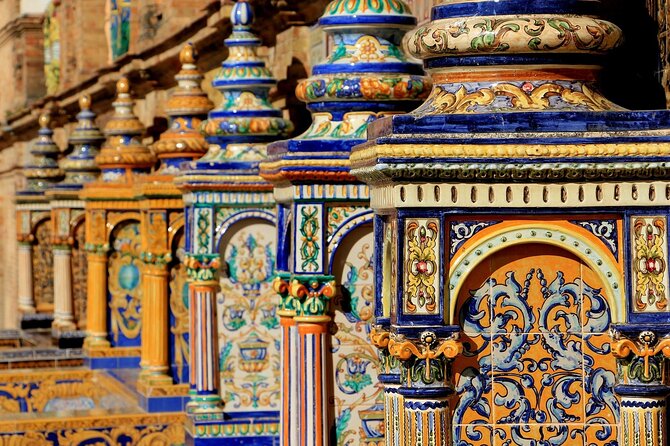
At $30.25 per person, the price buys a licensed English-speaking guide, a small group, and a guided route through several of Seville’s most recognizable landmarks. You are paying for interpretation and orientation, not admission. That distinction matters: tickets and visits inside the monuments are excluded, so budget separately if you plan to enter the Cathedral or Alcázar.
For a short stay, the value is strong. In roughly two hours, you can see the main landmarks from outside and build a useful map of the city’s history. If you are staying longer and enjoy independent research, you could walk between the sights on your own, but you would miss the guide’s explanations and the opportunity to ask questions as the story unfolds.
The group cap is another part of the value. With no more than 10 people, the guide has a better chance of being heard and adapting the walk to the group. It is not a private tour, but it is a more personal format than a large crowd.
Who should take this walk?
I would choose this tour if you are new to Seville, have limited time, or want context before visiting the major monuments on your own. It is also a good fit if you like learning through stories and want a guide who can connect buildings to the city’s wider past.
It is less suitable if your main goal is to go inside several monuments during one outing. This tour does not include tickets or interior visits, and its short format keeps the focus on an overview. If you want to spend an hour or more inside the Cathedral or Alcázar, plan those visits separately.
The route is a walking activity, and the information provided says most people can participate. It is near public transportation, and service animals are allowed. The walk’s length is manageable for many people, but allow for the possibility that it runs beyond two hours.
Should you book the Seville Monumental Highlights walk?
Book it if you want a compact, guided introduction that links Seville’s landmark exteriors to its changing history. The strongest reasons are the small group, the range of sights, and guides who can make a short walk feel worthwhile through clear, engaging commentary.
Skip it if you are looking for a ticketed tour inside the Cathedral or Alcázar, or if you need a precise end time. For most first-time visitors, though, it is a sensible way to get oriented, spot the places you want to return to, and make the city’s many layers easier to understand.
FAQ
How long is the tour?
It is listed as approximately two hours. The walk may take closer to two and a half hours, so leave some time afterward.
What is the price?
The stated price is $30.25 per person.
What language is the tour offered in?
The tour is offered in English, with a licensed English-speaking guide.
How many people are in the group?
The maximum group size is 10 people.
Where does the tour start?
It starts at Plaza de San Francisco, 17, in Seville’s old center.
Where does the tour end?
It ends at Plaza de España, on Avenida Isabel la Católica.
Are monument tickets included?
No. Tickets and visits inside the monuments are not included.
Which sights are covered?
The route includes City Hall, the Cathedral and Giralda, the Alcázar from outside, Torre del Oro, the old Tobacco Factory, and Plaza de España.
Can Plaza de España be closed during the tour?
Yes. The city council can close Plaza de España during a heavy wind alert.
Are service animals allowed?
Yes. Service animals are allowed on the tour.
Newest tours in Seville
- Intimate Flamenco: Exclusive Experience in Sevilla★ 4.9 · 69 reviews
- Highlights of Seville Monuments private Guided Tour★ 4.9 · 4 reviews
- From Seville: Horseback Riding Experience in Aljarafe★ 4.3 · 51 reviews
- From Seville: Andalusian Horseback Ride★ 4.9 · 28 reviews
- Heritage Córdoba: The most essential tour in Córdoba★ 5.0 · 8 reviews
- Enchanted Seville: Private Walking Tour★ 4.6 · 3 reviews
- Guided tour of Cadiz in French with a local guide★ 5.0 · 43 reviews
- Guided visit on foot through Cádiz: stories from the hand of a local guide★ 4.9 · 62 reviews
Andalusia Walking Tours, compared.

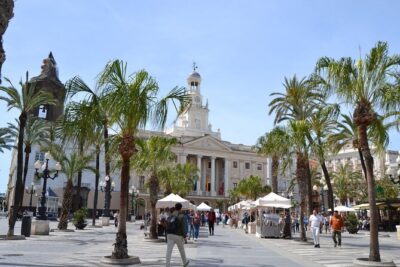
Walking Tour through Cádiz: Stories from the hand of a local guide
Read our review →
Small-Group Jewish Quarter Discovery Walking Tour
Read our review →
English Cádiz Tour: Walking Tour with Local Guide
Read our review →
Guided Walking Tour with English or Spanish Guide
Read our review →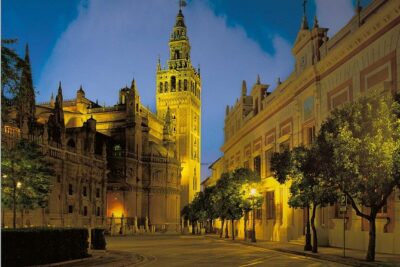
Seville Private Walking Tour with Alcazar & Cathedral Tickets
Read our review →Browse the lists this tour appears in